


![The Godhra massacre [ Gujarat, India ]](https://projecthindukush.com/wp-content/uploads/447397-godhra-train-burning.jpg)
![The Godhra massacre [ Gujarat, India ]](https://projecthindukush.com/wp-content/uploads/godhrakb.jpg)
![The Godhra massacre [ Gujarat, India ]](https://projecthindukush.com/wp-content/uploads/maxresdefault-1.jpg)
![The Godhra massacre [ Gujarat, India ]](https://projecthindukush.com/wp-content/uploads/sabarmati-express-759.jpg)
[ Reported as seen ]
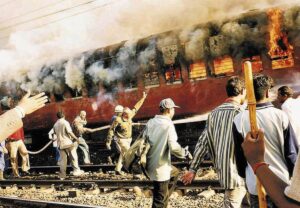
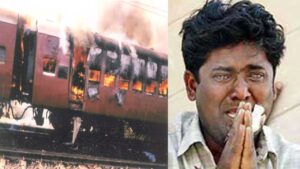
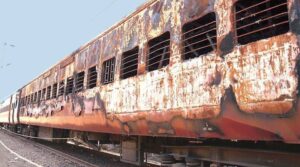
In February 2002, a significant event unfolded as thousands of devotees, known as “Ramsevaks” or “Kar Sevaks,” traveled from Gujarat to Ayodhya for a ceremony organized by the Vishva Hindu Parishad. On February 27, the Sabarmati Express train arrived in Godhra, where an abrupt emergency brake was pulled, halting the train near a signal point. A mob attacked the train, pelting stones and setting fire to four coaches, trapping passengers. Sadly, 59 people, including women and children, lost their lives, while 48 others were injured. The cause of the fire remains disputed, with conflicting conclusions from different investigations and scholars. The incident continues to be a subject of debate, with far-reaching implications and consequences. A comprehensive and impartial examination is necessary to seek justice and a nuanced understanding of this tragic event.
Introduction
The Godhra train burning, a tragic incident that took place on the morning of 27 February 2002, continues to be a subject of controversy and dispute. It unfolded when a fire engulfed the Sabarmati Express near the Godhra railway station in Gujarat, India, resulting in the loss of 59 lives. The victims were Hindu pilgrims and karsevaks returning from Ayodhya. The exact cause of the fire remains a matter of contention and differing accounts.
In the aftermath of the Godhra train burning, Gujarat witnessed a series of devastating riots characterized by widespread and severe violence primarily targeting the Muslim community. These riots erupted shortly after the incident, further intensifying tensions and exacerbating the already volatile situation.
The state government responded swiftly by appointing the Nanavati-Mehta commission to investigate the events. In 2008, the commission released its findings, concluding that the train burning was a pre-planned act of arson perpetrated by a large Muslim mob numbering around a thousand individuals. However, these findings have been subject to skepticism and criticism from scholars and experts who remain unconvinced about the claims of deliberate arson.
In contrast, the Banerjee commission, established by the Ministry of Railways, characterized the fire as an accident in 2006. However, the Gujarat High Court later declared the appointment of the Banerjee commission unconstitutional, effectively nullifying its findings.
Additional investigations by non-governmental organizations have supported the theory that the fire was an accident rather than an intentional act of violence. This further complicates the understanding of the incident and contributes to the ongoing debate surrounding its true nature.
In 2011, a trial court convicted 31 individuals, all Muslims, for their alleged involvement in the burning. The Nanavati-Mehta Commission’s report played a crucial role as evidence in the trial. Subsequently, in October 2017, the Gujarat High Court upheld these convictions, solidifying the legal outcome of the case.
The Godhra train burning and its aftermath continue to evoke strong emotions and remain a topic of intense discussion and controversy. The incident has left a lasting impact on the affected communities and serves as a painful reminder of the deep divisions that can arise within society. The quest for truth, justice, and reconciliation remains a vital imperative as the nation strives to heal and move forward from this tragic chapter in its history.
The massacre
In February 2002, a significant event unfolded as thousands of devotees, known as “Ramsevaks” or “Kar Sevaks,” embarked on a journey from Gujarat to Ayodhya. Organized by the Vishva Hindu Parishad, they were participating in the Purnahuti Maha Yagna ceremony. On 25 February, a group of around 1,700 people, comprising both pilgrims and karsevaks, boarded the Sabarmati Express bound for Ahmedabad.
The incident took place on 27 February 2002 when the train arrived at Godhra, albeit several hours behind schedule, at 7:43 am. As the train departed from the platform, the emergency brake was abruptly pulled, bringing the train to a halt near a signal point. The train driver later reported multiple instances of the chain being pulled, based on the instruments in his cabin.
According to one account, a mob of approximately 2,000 individuals attacked the train. Stone-pelting ensued, followed by the setting ablaze of four train coaches, resulting in the entrapment of numerous passengers. Tragically, 59 people, including women and children, lost their lives in the fire, while 48 others sustained injuries.[citation needed] J. Mahapatra, additional director general of the Gujarat police, stated that the miscreants had prepared petrol-soaked rags in advance of the train’s arrival at Godhra.
The cause of the fire remains a subject of dispute. In 2008, the Nanavati-Mehta Commission submitted Part I of its report, which examined the Godhra train burning incident. The commission concluded that the burning of the S-6 coach of the Sabarmati Express near Godhra railway station was a “planned conspiracy.” However, several independent commentators and inquiries have put forth differing conclusions. In 2003, the Concerned Citizens Tribunal determined that the fire was an accident.
Numerous scholars and experts have supported the assertion that the fire was likely an accident, with the initial cause remaining inconclusive. Ainslie Thomas Embree, a historian, dismissed the official narrative that the attack on the train was organized by individuals under orders from Pakistan, deeming it entirely baseless. Martha Nussbaum, a scholar, has challenged the prevailing narrative as well, highlighting multiple inquiries that concluded the conflagration resulted from an accident rather than a planned conspiracy.
The Godhra train burning has had far-reaching implications, shaping perceptions and triggering a series of events that unfolded in its aftermath. The incident has remained a subject of intense debate, with contrasting interpretations and narratives complicating the understanding of the event. It stands as a tragic chapter in history, leaving behind profound consequences for the affected individuals, their families, and the broader society.
In seeking justice and truth, it is crucial to examine all perspectives, drawing upon comprehensive and impartial investigations. The ongoing discussions and examination of the Godhra train burning continue to shape the collective understanding of the incident, its causes, and its implications. By critically analyzing the evidence and fostering open dialogue, we can strive towards a more nuanced and informed perspective on this deeply tragic event.
Inquiries
The inquiry into the Godhra train burning incident involved the examination of multiple reports and the subsequent reactions they elicited. One notable report was conducted by the Gujarat Forensic Science Laboratory, which stated that the fire resulted from the pouring of an inflammable liquid into the coach by the attackers. It also noted that the fire originated from the inside, explaining the lesser scorching on the coach’s exterior below the windows.
Following the incident, the Gujarat government established a commission of inquiry on 6 March 2002, initially led by retired Gujarat High Court judge K G Shah. However, due to concerns about Shah’s alleged proximity to Narendra Modi, the victims, human rights organizations, and political parties demanded the appointment of a Supreme Court judge to the commission. Consequently, the commission was reconstituted as a two-member committee, with retired Supreme Court judge G T Nanavati leading the way. It became known as the “Nanavati-Shah Commission.”
The committee’s work spanned six years, during which it examined over 40,000 documents and the testimonies of more than 1,000 witnesses. Initially set for a three-month term, the committee received 22 extensions until June 2014 to submit its final report. In September 2008, the commission submitted “Part I” of the report, which supported the Gujarat police’s theory of the incident. It identified Maulvi Husain Haji Ibrahim Umarji and a dismissed Central Reserve Police Force officer named Nanumiyan as the alleged “masterminds” behind the operation. However, some have questioned the validity of the evidence, particularly a statement made by Jabir Binyamin Behra, a criminal in custody at the time, who later denied making such a statement. The report also highlighted the alleged acquisition of petrol before the train’s arrival and forensic evidence indicating that fuel was poured on the coach before the fire. It concluded that thousands of Muslims from the Signal Falia area had attacked the train.
The commission’s findings drew mixed reactions. The Communist Party of India (Marxist) and the Indian National Congress objected to the exoneration of the Gujarat government, suggesting that the report’s timing was politically motivated, as general elections were approaching. Critics, including academics such as Christophe Jaffrelot, accused the commission of obstructing justice, prematurely endorsing conspiracy theories, and ignoring evidence of potential governmental complicity in the incident.
In September 2004, Lalu Prasad Yadav, the railway minister of the newly elected United Progressive Alliance government, appointed former Supreme Court Justice Umesh Chandra Banerjee to investigate the incident. In January 2005, Banerjee presented his interim report, tentatively categorizing the fire as an “accidental fire” and citing forensic evidence that suggested internal fire-related injuries to the victims. The report also criticized the railways’ handling of evidence pertaining to the case.
However, Banerjee’s findings were subsequently challenged in the Gujarat High Court by an injured individual, Neelkanth Tulsidas Bhatia. In October 2006, the court invalidated Banerjee’s conclusions, deeming the investigation “unconstitutional, illegal, and null and void.” The court stated that the report’s formation constituted an abuse of power with malicious intent, and its argument of an accidental fire contradicted accepted prima facie facts on record. The court also prohibited the report from being presented in Parliament.
The reactions to Banerjee’s report varied among political parties. The Bharatiya Janata Party (BJP), then in opposition, dismissed the
report as an attempt to gain an advantage in the upcoming Bihar elections. The BJP welcomed the High Court’s judgment, viewing it as a setback for the Congress party. Conversely, Lalu Prasad Yadav, the railway minister at the time, cited the report as evidence of the Narendra Modi government’s orchestration of the subsequent riots, describing it as an exposé of the BJP’s role.
The inquiry into the Godhra train burning incident generated substantial controversy and differing interpretations. The competing reports and reactions have contributed to a complex and contentious narrative surrounding the incident and its aftermath. As discussions and debates continue, it remains crucial to approach the subject with a commitment to justice, thorough investigation, and the pursuit of truth, ensuring that all parties involved receive a fair and impartial evaluation.
Trial and verdict
After the Godhra train burning incident, arrests were made, and a trial ensued to determine the guilt or innocence of the accused. By February 28, 2002, 51 individuals had been arrested on charges of arson, rioting, and looting. One of the chief suspects, Haji Bilal, a local town councillor and Congress worker, was captured on March 17, 2002. The charge-sheet filed by the Special Investigation Team (SIT) stated that a mob of around 1,540 unidentified people attacked the Sabarmati Express, resulting in the deaths of 59 people. A total of 68 people were accused, with 57 charged with stoning and torching the train, and 11 charged with being part of the mob. Over the course of the trial, 253 witnesses were examined, and more than 1,500 pieces of documentary evidence were presented.
The trial was marked by legal developments and changes in the charges against the accused. Initially, the Prevention of Terrorism Ordinance (POTO) was invoked against the accused but was later suspended due to pressure from the central government. In May 2003, the first charge sheet was filed, but the accused were not charged under POTA. However, in February 2003, POTA was re-invoked against all the accused. The trial faced a setback when the Supreme Court stayed the proceedings in November 2003. The POTA was eventually repealed in 2004 after a change in government, and the accused were not charged under POTA following a review. In 2009, a special fast-track court was established based on the SIT report, and the trial commenced in May 2009.
The trial court delivered its verdict in February 2011, convicting 31 people and acquitting 63 others. The court found that the incident was a planned conspiracy. Eleven convicts were sentenced to death, and twenty others were sentenced to life imprisonment. The prime conspirator, Maulvi Saeed Umarji, was acquitted along with 62 others due to a lack of evidence. Both the convicted and acquitted parties filed appeals in the Gujarat High Court.
In October 2017, the Gujarat High Court upheld the earlier life sentences of 20 convicts and commuted the death sentences of the remaining 11 convicts to life imprisonment. The court also re-acquitted the 63 individuals who had been previously acquitted by the trial court. The state government and railways were ordered to pay compensation to the families of each of the 59 victims.
The trial and court verdict were met with differing reactions. The BJP spokesperson welcomed the verdict, stating that it proved the government’s theory wrong. The Congress Party’s Law Minister refrained from commenting, emphasizing that the courts would take their own course. The head of the SIT expressed satisfaction with the verdict, while the BJP spokesperson claimed that it exposed the alleged cover-up by the previous government.
It’s important to note that the information provided is based on the available knowledge up until September 2021. For the most accurate and up-to-date information on the trial and court verdict, it is recommended to refer to recent news sources or official reports.
Aftermath
The aftermath of the Godhra train burning incident and the Gujarat riots that followed had a significant impact on various aspects of society, including the arts and media. The incident and its consequences served as a backdrop for several films and documentaries, reflecting the interest and attention it garnered.
In 2005, the film “Chand Bujh Gaya” incorporated the Godhra train burning incident as the background for a love story. This cinematic portrayal aimed to capture the emotional and human aspects of the incident and its impact on individuals’ lives.
Another notable film that touched upon the Gujarat riots was “Kai Po Che!” released in 2013. Based on Chetan Bhagat’s novel “The 3 Mistakes of My Life,” the movie used the backdrop of the riots to drive the main narrative. It explored themes of friendship, dreams, and the challenges faced by individuals amidst the turmoil of communal violence.
Additionally, the documentary “Final Solution,” released in 2004, delved into the train burning incident and the subsequent Gujarat riots. Through interviews, testimonies, and footage, the documentary shed light on the events and their consequences, providing a deeper understanding of the social and political implications of the incidents.
These artistic endeavors sought to depict and explore the human stories, emotions, and social dynamics surrounding the Godhra train burning and the Gujarat riots. By using the medium of film and documentary, they aimed to raise awareness, provoke discussions, and contribute to a broader dialogue about the incident and its aftermath.
It is worth noting that the impact and reactions to these artistic works varied. Some praised their efforts to shed light on the incidents and their consequences, while others critiqued them for their portrayal or interpretation. Nevertheless, these films and documentaries played a role in keeping the incident alive in public consciousness and fostering discussions about the larger issues it represented.
It is important to acknowledge that this information is based on the available knowledge up until September 2021. For the most accurate and up-to-date information on the aftermath of the Godhra train burning incident and the Gujarat riots, it is recommended to refer to recent news sources or official reports.
Conclusion
The Godhra train burning incident and the subsequent Gujarat riots were tragic events that left a profound impact on society. The incident itself, along with the communal violence that followed, resulted in loss of lives, destruction of property, and a deepening of religious and communal divides. The aftermath of these events has been a subject of intense scrutiny, legal proceedings, and social reflection.
The investigations and trials that followed the Godhra incident were complex and garnered significant attention. Many people were arrested and charged in connection with the train burning, and the legal process took several years to reach a conclusion. The use of the Prevention of Terrorism Act (POTA) and its later suspension added further complexity to the legal proceedings.
The court verdict, delivered in 2011, brought convictions for some, while others were acquitted due to lack of evidence. The verdict sparked debates and reactions from various quarters of society. Some praised the judicial process, while others criticized it, leading to ongoing discussions about the fairness of the trial and the handling of evidence.
The aftermath of the Gujarat riots also left a lasting impact on the affected communities. Families of the victims and survivors struggled to rebuild their lives amidst the trauma and grief. The riots exposed deep-rooted communal tensions and raised questions about the role of law enforcement and political leaders in maintaining peace and harmony.
The arts and media played a role in keeping the memories of the Godhra incident and the Gujarat riots alive in public consciousness. Films and documentaries portrayed the incidents from different perspectives, aiming to shed light on the human stories and emotions intertwined with the larger political and social context. However, these artistic representations were not without controversy and elicited diverse reactions.
As society moves forward from these tragic events, there is a need for continued efforts to foster harmony, understanding, and empathy among different communities. Acknowledging the past and learning from it can pave the way for a more inclusive and tolerant society.
It is crucial for institutions and individuals to work towards preventing such incidents in the future and ensuring that justice is served to all victims. This requires a collective commitment to upholding the rule of law, promoting interfaith dialogue, and addressing underlying socio-economic disparities that can exacerbate communal tensions.
Ultimately, the Godhra train burning incident and the Gujarat riots stand as reminders of the grave consequences that intolerance and hatred can bring. As a society, we must strive for unity, respect, and compassion, recognizing that our diversity is our strength and that embracing it is the path to lasting peace and progress.
CITATIONS AND SOURCES
Godhra carnage: The lie of dead body parade, how ‘liberals’ shame Hindus even in death


